


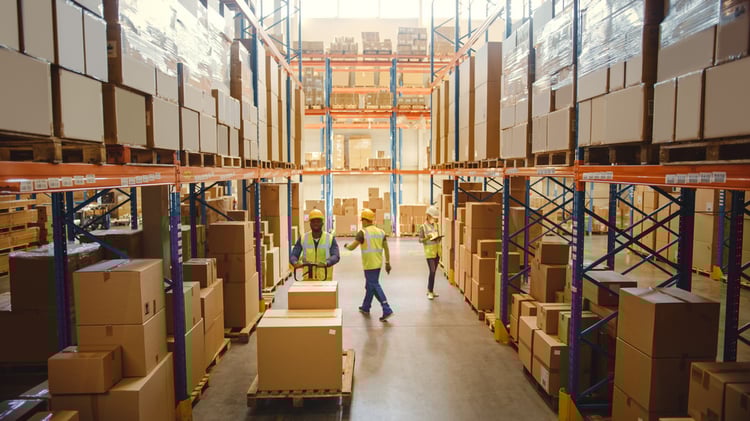
From labor shortages to rising fulfillment demands, discover how mobile workstations help distribution centers overcome today's biggest operational challenges.
TL;DR: Distribution centers are under constant pressure to increase throughput while controlling labor costs and maintaining order accuracy. A powered cart helps eliminate unnecessary travel by giving workers access to computers, scanners, and printers wherever work happens.
- Warehouse labor shortages continue to impact productivity and efficiency
- Workers lose valuable time walking between fixed workstations
- Mobile workstations bring technology directly to the point of work
- Real-time access helps improve inventory accuracy and order fulfillment
- Empowering employees often delivers faster results than large-scale automation
Modern distribution centers are under more pressure than ever. Rising order volumes, labor shortages, tighter delivery windows, and increasing customer expectations mean every second counts.
The good news? Improving productivity doesn't always require massive automation investments or expensive robotics. A powered warehouse cart gives frontline workers the tools they need exactly where they need them. Instead of walking back and forth to workstations, employees can scan, print, and access real-time data without interrupting their workflow.
In this article, we'll explore the biggest challenges facing today's distribution centers and how mobile workstations help.
Why Distribution Centers Need Better Mobile Technology
Warehouses and distribution centers are fast-paced, demanding environments. While many facilities continue investing in automation and digital transformation, not every technology solution is designed to withstand the realities of warehouse operations.
Warehouses are demanding environments where handheld computers, tablets, and scanners are routinely exposed to drops, vibration, dust, temperature changes, and constant daily use. As a result, organizations often invest in ruggedized devices designed to reduce downtime and maintenance costs. At the same time, businesses are expected to process more orders with fewer resources while maintaining accuracy and fast delivery times.
That's why more operations are turning to powered warehouse carts that bring technology directly to the point of work.
The Biggest Challenges Facing Today's Distribution Centers
Every warehouse faces unique operational demands, but several challenges continue to affect facilities across the industry.
Finding and Retaining Talent
 Perhaps the biggest challenge is labor.
Warehouse employees often change jobs in search of better working conditions and roles that are less physically demanding. Repetitive tasks and constant walking between fixed workstations can lead to fatigue and frustration over time.
Providing employees with tools like a powered mobile cart helps eliminate unnecessary movement, simplifies tasks, and creates a more efficient work environment. This leads to higher job satisfaction and improved employee retention.
Inventory Management
Inventory visibility is essential for efficient warehouse operations.
Distribution centers must accurately receive, store, locate, and replenish inventory while avoiding overstocks, shortages, and obsolete or damaged products. Without real-time access to inventory, workers waste valuable time searching for products or traveling to stationary computers.
Mobile technology helps workers update inventory instantly from anywhere on the warehouse floor.
Order Errors
As order volumes continue to increase, even small fulfillment errors can become costly.
Incorrect shipments and labeling mistakes create unnecessary rework, increase return costs, and impact customer satisfaction. Improving access to scanning and labeling directly at the point of work helps reduce these avoidable mistakes.
Meeting Higher Productivity Expectations
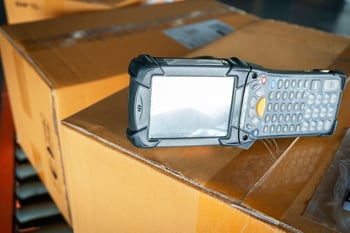 Customer expectations continue to rise. Smaller, more frequent orders have become the norm, forcing distribution centers to maximize every worker's productivity. Reducing unnecessary travel and minimizing interruptions are simple ways to increase throughput without adding labor costs.
What is a Powered Mobile Cart?
A powered mobile cart is a rugged workstation designed for warehouse and distribution center environments.
Instead of relying on fixed computer stations, employees can bring their workstation with them. Depending on operational needs, these mobile workstations can include:
- Computer and monitor
- Barcode scanner
- Label printer
- Shipping printer
- Workspace for supplies
- Integrated battery power
Most battery-powered warehouse carts include maintenance-free batteries, integrated power systems, and charging capabilities that provide reliable power throughout an entire shift.
Unlike traditional fixed workstations, a battery powered cart allows employees to bring technology directly to the task.
How Powered Carts Improve Distribution Center Performance
Warehouse modernization doesn't always require robots or fully automated facilities. Sometimes the biggest operational gains come from giving workers better tools.
Here's how powered carts are transforming distribution center operations.
Reduce Walking and Increase Productivity
One of the biggest productivity killers in any warehouse is excessive travel. Workers frequently walk 5 to 10 miles per shift between work areas and fixed computer stations.
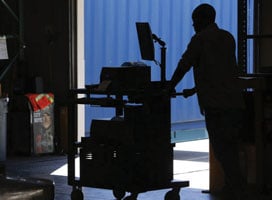
A powered mobile cart travels with the employee, allowing them to print labels, access inventory systems, scan barcodes, and complete transactions wherever work happens.
The result is:
- Less walking
- Faster task completion
- Reduced worker fatigue
- Higher overall productivity
Lower Cost Per Pick
Order picking represents one of the largest labor costs in warehouse operations. Every unnecessary trip to retrieve paperwork, labels, or system information adds time and increases cost per pick.
Bringing technology directly to the picker eliminates interruptions that slow down fulfillment. Workers can move continuously through picking routes while accessing the information they need in real time.
Reducing these delays helps lower the overall cost per pick.
Improve Order Accuracy
 Accurate orders begin with accurate information. Immediate access to warehouse systems helps workers verify information before products leave the facility.
Scanning products at the point of work, printing labels immediately, and updating inventory in real time contribute to better order accuracy and fewer shipping mistakes.
Create More Flexible Warehouse Space
Traditional computer stations occupy valuable warehouse floor space.
Using battery-powered warehouse carts allows organizations to reduce dependence on fixed workstations. This also helps create more flexible layouts that can adapt as operations grow. The additional space can be used for inventory, staging, or other value-producing activities.
Reduced Operating Costs Without Sacrificing Performance
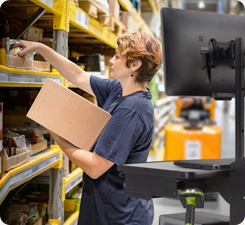 Improving productivity doesn't always require adding more labor.
By reducing unnecessary movement, improving worker efficiency, and streamlining workflows, powered carts help organizations accomplish more without adding headcount.
Instead of asking employees to work harder, mobile technology enables them to work smarter. This improves both productivity and overall job satisfaction.
Empower Your Workforce with Powered Carts
Today's distribution centers need practical technology that helps workers perform at their best.
A powered warehouse cart gives employees real-time access to the tools and systems they need. This helps them work faster, improve accuracy, and reduce unnecessary movement throughout each shift.
Rather than replacing workers, mobile workstations empower them to accomplish more while creating safer, more efficient warehouse operations.
Ready to Modernize Your Distribution Center?
Discover how Newcastle Systems' powered mobile workstations help warehouse teams reduce travel, improve accuracy, and increase productivity across every shift.
Explore Newcastle Systems' mobile workstation solutions
|
Eliminate Costly "Waste" in the Warehouse with Mobile Power |
