


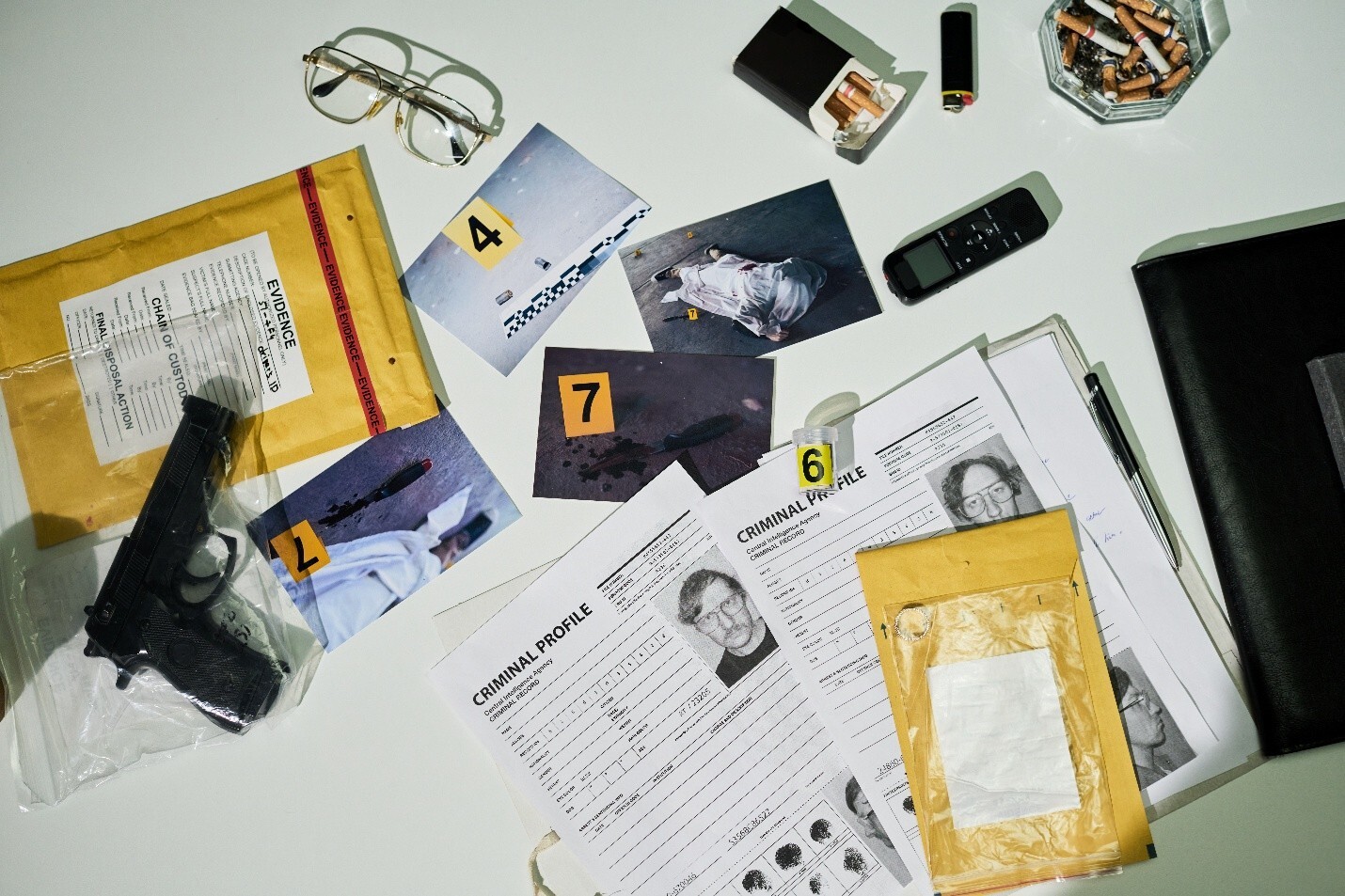
"Every hand it passes through must be documented – you break the chain, you break the case."
Quotes like the one above are something fans of Police Procedural shows hear in almost every episode. Clearly the importance of proper evidence handling is paramount in the legal process from its initial collection by law enforcement to any downstream handling in labs, court, law offices or wherever it may go – including the possible long-term storage in a cold facility where it may be preserved for a future day where more evidence might lead to making it relevant in an old, unsolved case.
Without saying it, it’s clear that a process like this is a sensitive one, involving labels, packaging, tracking of movement (“delivery”), storage location, categorization and more.And like many other industries where labeling is mission-critical, adding mobility into the solution also provides tremendous opportunities to improve accuracy, efficiency and speed to an area where people’s lives are often actually at stake.
The Basics of Evidence Handling
Evidence handling is almost a science and a profession unto its own. But for today’s topic, we’ll just summarize the Ten most important steps on a high level:
- Collection – This is where things like protective gear, sterile tools for handling physical evidence and Ziploc bags are required tools to avoid contamination. For digital assets, write-blockers are required to prevent possible modification of data.
- Documentation – Everything gets photographed (in situ before handling), sketched, noted and logged digitally (at the collection point or later from the notes). Photos and sketches need to be accurate, depict scale and show context from the scene without bias.
With evidence now collected and returned to the lab or other initial destination, we now get into the fun part:
- Labels and Tags – All items need permanent (and legible!) labels or tags with identifying data like case numbers, collection date and other custody information.
- Classification - Evidence should be grouped using some kind of logical system that is not a cryptic puzzle for outsiders. Case, evidence type, location, dates, sources, etc. A master index is to ensure all items have unique identifiers and can be quickly retrieved.
- Digital Cataloging – Specialized evidence management software can be leverage to track ALL evidence - digital or physical – and allow for the use of RFID tagging, barcodes and other metadata to provide unique identifiers for quick retrieval.
- Protecting the Chain of Custody – the namesake for the entire process, in this context it refers to the accurate documentation of every movement in the process for the evidence. Documenting dates, times, personnel involved, and PURPOSE are critical to maintaining accountability and avoiding having it deemed legally inadmissible.
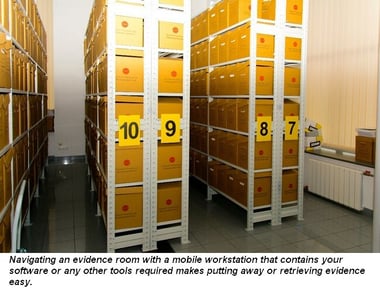 Now, those four steps should be a very big hint as to why Mobile Workstation Carts may have the potential to be an indispensable tool in the evidence handling process. Let’s wrap up the high-level steps – which are all focused on storage and preservation - and then dig in a bit deeper:
- Tamper-Evident Packaging – tamper-proof containers (and maintaining write-protection for digital items). There is also a great case here for tamper-proof security labels as well.
- Secure Storage -Aside from secure evidence rooms, smaller facilities without them should be using lockable cabinets, fireproof safes or anti-static containers, and ideally restrict access, monitor with video and maintain access logs (ideally connected to your software)
- Environmental Controls -Be it a chemical, biological or electronic item, each type of evidence should be maintained in the most appropriate environment that prevents degradation – including correct humidity, lighting, etc.
- Retention and/or Disposal – this step is mostly about reducing clutter and being compliant with local laws and regulations (as some items may be biohazards or have other potentially harmful impacts). However, other items may need to be preserved for decades if it is a cold case, or a case with a lengthy drawn out appeals process.
Now let’s revisit Steps 3-7 and take a quick look on how a mobile workstation might make the process more efficient, and possible even more secure.
The Six Benefits of Mobile Carts in Evidence Handling?
 The evidence handling process lends itself now to certain improvements more than ever before because of advancements made in label printing, software and their mobility. Here are some of the benefits of bundling those technologies together on a set of wheels:
- Accuracy – When you have evidence to organize that might be in multiple rooms (i.e. a lab and an interview room) or very large items spread across a large space (i.e. vehicle or building wreckage in a hangar), having your evidence management software, scanner, camera and label printer on one mobile cart let’s you label and tag in place without moving the evidence or having to interrupt the work fetching labels somewhere else.
- Security – Moving and transferring evidence within a facility can be done more securely if they are moved on a cart that can also scan in their location changes
- Consistency – a mobile unit that frees up your equipment to be anywhere you need it in your facility means you can design a more sophisticated classification system and still maintain a high level of consistency.
- Integration – A mobile workstation allows your evidence handlers and labs to keep all their tools in one place, making integration everything you use to catalog, label and manage your evidence much easier
- Efficiency – without the burden of having to move evidence around to where you can do the processing, wasted footsteps will be eliminated and potential chain of custody issues can be avoided by not requiring operators to walk away from their workspace to obtain labels.
- Convenience – using a mobile cart creates a holistic solution for evidence handling that is both scalable and repeatable across an entire jurisdiction or multiple facilities.
And It’s Not the First Time
Newcastle System’s Mobile Workstation Carts are already deployed across multiple law enforcement agencies and legal jurisdictions including agencies like TSA and county court systems, where they are an integral part of a comprehensive document management system. Need to hear a bit more? Reach out to our contact in your region or to a trusted Reseller and see how we can customize a solution for your evidence handling process.
|
Eliminate Costly "Waste" in the Warehouse with Mobile Power |
