50 Best Lean Warehouse Productivity Tips

Author: Christine Wheeler, VP of Marketing

Last Updated: 10.20.2026

The fastest way to improve warehouse productivity is to remove wasted motion, errors and waiting from everyday work. This guide covers 50 practical lean tips across seven areas: warehouse productivity, organization, inventory management, picking accuracy, shipping and receiving, software and data, and safety. Each tip includes a way to measure whether it is working.

Running a lean warehouse is not about one big fix. It is about dozens of small decisions that help your team move faster, work more accurately and waste less time. Whether you manage warehouse operations, distribution, inventory or continuous improvement, use these tips to review your process with fresh eyes.

Download the printable version (PDF) to share with your team or use on the floor.

01 How can you increase warehouse productivity?

Small changes to how orders get picked and replenished add up to major productivity gains. Most of the opportunity sits in travel time, waiting and rework.

1. Put fast movers within easy reach

Review pick frequency and move your highest-volume SKUs to locations closest to pack-out, at waist height. Store items that are often ordered together near each other so one stop fills several lines. Re-slot at least quarterly, because velocity shifts with seasons and product changes.

How to measure it: Average travel distance or time per pick, before and after re-slotting.

2. Pick multiple orders in one trip
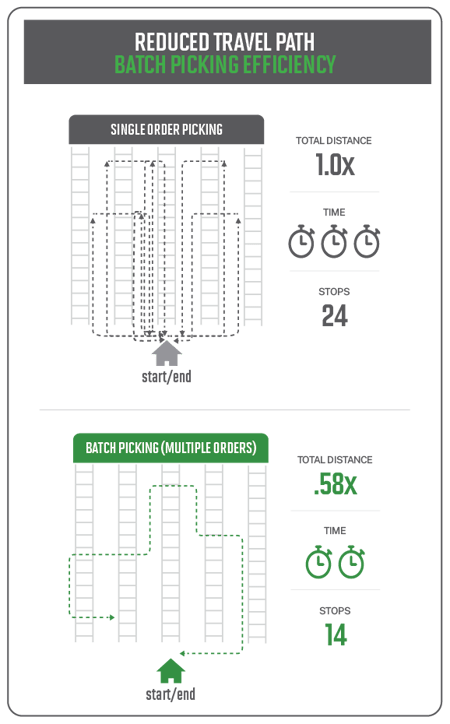
Batch Picking Comparison_VERT-1

Batch picking groups several orders into one pass through the aisles, so pickers stop

walking to the same location again and again. It works best for small orders with overlapping SKUs. Sort to individual orders at the end of the route or at a put wall.

How to measure it: Lines picked per hour and travel distance per order, compared with single-order picking.

3. Let zones work at the same time

Zone picking assigns each picker to one area of the floor, so several people pick simultaneously and orders are consolidated at the end. Pickers learn their zone deeply, which also improves speed and accuracy. Balance zones by workload, not square footage.

How to measure it: Order cycle time and picks per hour by zone, plus idle time when zones are unbalanced.

4. Reduce backtracking

Build pick paths that move in one logical direction through the building instead of crisscrossing the same aisles. Most WMS platforms can sequence pick lists by location automatically. A serpentine route through the aisles is often the simplest fix.

How to measure it: Travel distance per pick route, or the number of times a route revisits the same aisle.

5. Replenish before you run short

Schedule replenishment from reserve storage to pick faces proactively, based on min/max levels, so pickers never wait on stock you already have. Time replenishment for low-activity windows so it does not compete with picking. A pick face that runs empty mid-wave stalls everyone behind it.

How to measure it: Number of stock-outs at the pick face and minutes pickers spend waiting for replenishment.

6. Measure walking time

Track how much of each shift your team spends walking compared with picking, packing or other value-added work. Travel is often the largest single share of picking labor, so even small reductions add up fast. Time studies or WMS location data both work.

How to measure it: Walking time as a percentage of total labor hours, tracked by shift or role.

7. Look at the full cost of labor

When comparing process changes or equipment, include overtime, errors, rework, turnover and injuries, not just hourly pay. A change that saves a few minutes per shift but cuts injuries or mispicks often pays back faster than its labor savings alone suggest. Build the full cost into every business case.

How to measure it: Fully loaded cost per order or per unit shipped.

8. Build for peak volume

Design daily processes that can scale when demand spikes, rather than inventing new ones under pressure. Standard work, cross-trained staff and equipment that can be moved to where demand is heaviest make peak season a volume change instead of a process change. Run a pre-peak review each year.

How to measure it: Orders per labor hour and on-time ship rate during peak, compared with normal weeks.
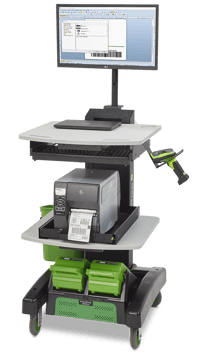
Reduce non-value-added walking with mobile power carts.

Every trip back to a stationary workstation or wall outlet is a walk that doesn't move product. Mobile power carts bring the scanner, tablet and label printer to the work, at receiving, in inventory control, during returns processing, at pack-out and on the shipping dock, so the technology moves with the associate instead of the associate walking to the technology. 

NB SERIES WORKSTATION

02 How should you organize a warehouse for lean operations?

Reclaiming space and straightening out flow costs little and pays off immediately. Start with the space and layout you already have before adding square footage.

9. Reclaim vertical space

Look up before you look for more square footage. Taller racking, mezzanines and vertical storage recover capacity in a building you are already paying for. Check clear height, sprinkler clearance and lift equipment reach before you build up.

How to measure it: Cubic storage utilization, the share of usable building volume actually holding inventory.

10. Map facility flow in one direction

Product should move one way through the building: receiving, then storage, then picking, then packing, then shipping. When flows cross or double back, people and equipment collide and touches multiply. Walk the path of a typical order and mark every place it reverses direction.

How to measure it: Number of touches per unit from dock to dock, and travel distance from receiving to putaway.

11. Store products in bins and totes

Open shelving exposes inventory to dust, damage and contamination. Bins, totes and dividers keep products clean and separated, make locations easier to label, and increase storage density for small parts. They also make cycle counts faster because each location holds one clearly defined SKU.

How to measure it: Damaged or unsellable inventory write-offs, and locations per square foot of shelving.

12. Design your facility for scalability

Racking and shelving that fits today's product mix may not fit it in five years. Choose adjustable or modular storage and leave room in the layout to grow, so a new product line doesn't force a rushed, costly retrofit. Mobile equipment that can be redeployed adds flexibility at low cost.

How to measure it: Available capacity headroom (open locations as a share of total) against your growth forecast.

13. Tighten shelving to fit the product

Reduce dead space between shelves and group items of similar height together. Adjusting beam or shelf heights to the product often adds meaningful capacity without adding a building. Revisit shelf spacing whenever product dimensions change.

How to measure it: Location fill rate, the share of each location's volume actually occupied.

14. Keep aisles clear and right-sized

Give forklifts and pickers enough room to move safely, but not so much that you are paying for empty aisle. Aisle width should match the equipment you actually run. Keep aisles free of pallets, totes and staged product that force detours.

How to measure it: Aisle space as a share of total floor space, and aisle obstructions logged during floor walks.

15. Keep workspaces clean and clutter-free

A clean workspace is not about appearances. Clutter around workstations is where damage, lost inventory and near-misses happen. A 5S program (sort, set in order, shine, standardize, sustain) makes cleanliness part of standard work instead of a monthly cleanup.

How to measure it: 5S audit scores by area, plus near-miss reports tied to housekeeping.

16. Add floor maps and wayfinding signage

Clear maps, aisle markers and directional signage cut the time new or temporary staff spend finding their way. This matters most in large or multi-zone facilities and during peak season, when seasonal hires need to be productive on day one. Make location labels readable from the travel path.

How to measure it: Time for new hires to reach standard pick rates.

03 What are the best lean inventory management practices?

Lean inventory means knowing exactly what you have, where it is and when it needs to be replaced. Accurate records are what make every other lean practice possible.

17. Set minimum reorder quantities

Automate reorder points so purchasing is notified before a part runs out, not after. Base each reorder point on lead time and average usage, plus a safety stock buffer for variability. This matters most in just-in-time operations, where a single stock-out can stop a line.

How to measure it: Stock-out frequency and fill rate (the share of order lines filled completely from stock).

18. Pick a rotation method that fits the product

FIFO (first in, first out) is essential for anything that can expire, degrade or go out of date. LIFO (last in, first out) can be practical for durable, non-perishable goods stored in deep lanes where only the front is accessible. Choose by product, not by habit, and make sure the storage layout supports the method.

How to measure it: Expired or obsolete inventory write-offs, and inventory age by SKU.

19. Cycle count instead of waiting for year-end

Count a small portion of inventory every day or week instead of shutting down for one annual physical count. Prioritize high-value and fast-moving SKUs (often called ABC counting) so the items that matter most are counted most often. Discrepancies get caught and corrected while the cause is still traceable.

How to measure it: Inventory record accuracy, the share of locations where system quantity matches physical quantity.

20. Weigh, don't hand-count, small parts

Counting scales calculate quantities from a sample weight, which is much faster and more accurate than hand-counting nuts, bolts and small components. They are especially useful at receiving and during cycle counts. Recalibrate sample weights whenever packaging or suppliers change.

How to measure it: Count time per location and count variance on small-parts SKUs.

21. Match storage method to SKU characteristics

Group inventory by velocity, size and weight, then store each group the way it moves. Bulky fast movers belong near the dock on the floor or low rack, while small, steady movers fit bins, carton flow or automated storage. The right method for each SKU adds up to real efficiency across the building.

How to measure it: Picks per hour by storage type, and travel time for the top 20% of SKUs by volume.

22. Protect high-value SKUs from theft

Layer your protection: inventory software that flags variances, cameras in open storage areas, and locks on cabinets and drawers. For your costliest items, RFID tagging makes it easy to find a missing unit. Controlled-access storage that records who took what adds accountability that open shelving can't.

How to measure it: Shrinkage rate (unexplained inventory loss as a share of inventory value) for high-value SKUs.

23. Track lot, batch and serial numbers for regulated inventory

In industries like medical devices, pharmaceuticals and aerospace, you need to know exactly which lot or serial number shipped in each order. Capturing it by scan at receiving and shipping makes a recall a targeted search instead of a guessing game. It also supports audit and compliance requirements.

How to measure it: Time to trace a lot or serial number from receipt to customer.

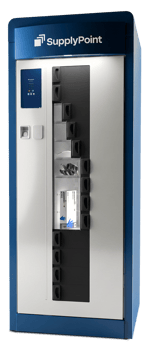
Asset lockers.

Open shelving isn't built to protect your highest-value or highest-shrinkage SKUs. Smart asset lockers restrict access to authorized users and log every checkout automatically, adding real accountability on top of the organizational gains above. 

SP Smart Lockers Sm

04 How can you improve picking accuracy in a warehouse?

Accuracy problems are usually process problems, not people problems. The fix is almost always in the workflow: confirm the right item, location and quantity at the moment of the pick.

24. Direct pickers with pick-to-light

Pick-to-light systems light up the exact location and display the quantity to pick, so pickers don't have to match part numbers to bin labels. They are most effective in high-volume areas with many small, fast-moving SKUs. Accuracy commonly exceeds 99% when the system is well maintained.

How to measure it: Mispick rate (errors per 1,000 lines picked) and lines picked per hour in pick-to-light zones.

25. Confirm every pick with a scan

Scanning both the location and the item verifies the right part, the right location and the right quantity in real time. If anything doesn't match, the picker knows immediately instead of the customer finding out. Mobile scanners and label printers at the point of work keep scanning fast enough that people don't skip it.

How to measure it: Order accuracy rate, the share of orders shipped with no errors.

26. Give hard-to-describe parts a photo

Add product images to pick screens and location labels for look-alike parts, components that differ only by size, or SKUs with confusing descriptions. Photos help new and temporary team members pick with confidence. They also reduce questions to supervisors during busy shifts.

How to measure it: Mispick rate on look-alike SKUs before and after adding images.

27. Use color picking for multi-picker zones

Assign a color to each picker, order or zone, using colored totes, labels or lights. When several people pick in the same area, color prevents duplicate picks and items landing in the wrong order. It is a low-cost fix that works with or without pick-to-light.

How to measure it: Duplicate and wrong-order picks in shared zones.

28. Reduce mispicks with automated retrieval

Carousels and vertical lift modules bring the right tray to the picker, and indicator lights point to the exact item. This goods-to-person approach removes both travel and searching. It is best suited to high-value, small or high-volume parts where accuracy and density both matter.

How to measure it: Mispick rate, picks per hour and floor space recovered.

29. Consider a pick-and-pass strategy

In pick-and-pass, each picker fills the lines for their zone and passes the order tote to the next zone, often on a conveyor. Pickers stay in a small area they know well, which means fewer trips and fewer errors. It suits orders with lines spread across several zones.

How to measure it: Order cycle time and accuracy rate, plus queue time between zones.

Accurate Picking ProcessFive-step accurate picking process. 1. Scan the pick location. 2. Confirm the item and quantity in the system. 3. Scan the item to verify accuracy. 4. Place the item in a tote or at the pack station. 5. Complete and record the order line.

05 How do you streamline warehouse shipping and receiving?

The last mile inside the building matters as much as the first mile outside it. Errors caught at the dock are the cheapest errors you will ever fix.

30. Pick straight into the shipping container

When order size and box size are predictable, pick directly into the carton that ships instead of transferring from a tote at pack-out. Cartonization in your WMS can choose the right box before picking starts. Removing one handling step saves time and reduces damage.

How to measure it: Touches per order and pack-out time per order.

31. Give consolidation its own zone

If you run zone, batch or parallel picking, orders have to come together somewhere. Give that area dedicated space, clear labeling and enough staging locations for peak volume, rather than squeezing it in next to the dock. A congested consolidation area quickly becomes the bottleneck for the whole building.

How to measure it: Dwell time in consolidation and orders waiting for missing lines.

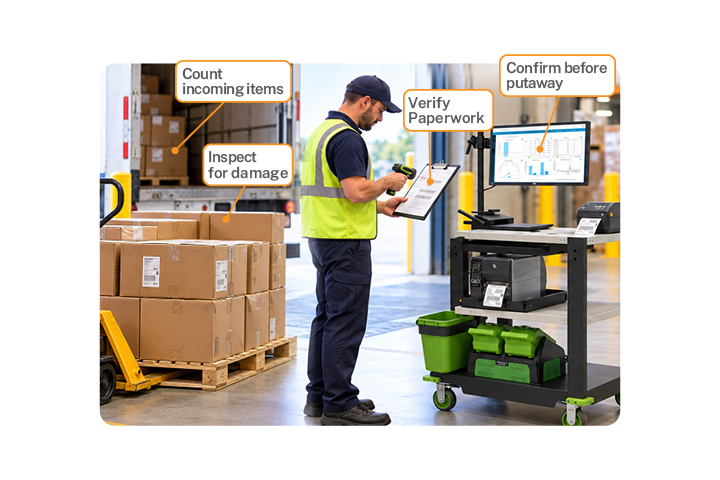
32. Inspect everything before it enters inventory

Check incoming product for damage, quantity and correct SKU at the dock, before putaway. A problem found at receiving can be refused or claimed against the supplier or carrier. The same problem found weeks later on the shelf is usually your cost.

How to measure it: Receiving discrepancy rate and supplier or carrier claims recovered.

33. Standardize returns handling

Returns are inevitable, and without a written process they pile up and clutter the floor. Define how returns are received, inspected, graded and dispositioned (restock, refurbish, return to vendor or scrap). A dedicated returns station with its own scanner and label printer keeps returns from interrupting outbound work.

How to measure it: Returns processing time from receipt to disposition, and the share of returns restocked.

34. Receive directly against open orders

When inbound product is already needed for a waiting order, send it straight to outbound instead of putting it away and picking it back out. This cross-docking approach removes a full putaway-and-pick cycle. It requires real-time visibility of open orders at the dock.

How to measure it: Share of inbound units cross-docked, and dock-to-ship time for those units.

35. Review your receiving process annually

Once a year, walk the receiving process end to end to confirm items are being properly counted, inspected and verified before they enter inventory. Look for steps that have drifted, been skipped or become workarounds. Update standard work and retrain as needed.

How to measure it: Dock-to-stock time, the hours from truck arrival to available inventory.

36. Monitor carrier performance

Keep a simple record of on-time pickup, on-time delivery and damage rates by carrier. Shared with carriers regularly, the data drives better service. It also gives you real numbers when a shipping contract comes up for renewal.

How to measure it: On-time performance and damage claims per 1,000 shipments, by carrier.

Warehouse worker using a mobile powered workstation to verify paperwork, inspect packages for damage, and confirm incoming inventory during the warehouse receiving process.

06 How can software and data improve warehouse productivity?

Data only helps if it is connected. Siloed systems can't warn you about anything, so the goal is one accurate, real-time picture of orders, inventory, people and equipment.

37. Connect your WMS and ERP

When your warehouse management system and ERP share data in real time, inventory, orders and purchasing all work from the same numbers. Connected systems can flag a shortage, a late shipment or a count variance before it becomes a customer problem. Disconnected systems leave people reconciling spreadsheets.

How to measure it: Inventory variance between WMS and ERP, and time spent on manual reconciliation.

38. Go paperless on the floor

Paper pick lists and log sheets get lost, go out of date the moment they print, and are hard to audit. Mobile computers, tablets and scanners give associates live tasks and capture every transaction as it happens. Power at the point of work keeps those devices running for the full shift.

How to measure it: Data entry errors and the lag between a physical transaction and its system record.

39. Track productivity by operator

Picks per hour and accuracy rates by associate show where training or process changes will actually move the needle. Use the data to coach and to spot process problems, such as one zone that is consistently slower. Compare like with like, since different zones and order types have different standards.

How to measure it: Picks per hour, accuracy rate and units per labor hour, by associate and by zone.

40. Review your processes each year

Technology you paid for but don't fully use isn't saving you anything. At least once a year, review which features of your WMS, scanners and automation are actually in use, and retrain where adoption has slipped. Check whether processes have drifted away from what the systems were configured to support.

How to measure it: Feature adoption rates and the number of manual workarounds found.

41. Use IoT where it adds visibility

Sensors and connected devices can monitor equipment status, battery levels, temperature, humidity and workflow in real time. Start where a blind spot costs you money, such as cold-chain storage, critical equipment uptime or asset location. Add sensors to answer a specific question, not just to collect data.

How to measure it: Unplanned equipment downtime and alerts that led to action.

42. Use a label printer to tag inventory

Barcode labels on every location, tote and unit make scanning possible, which improves accuracy, speeds picking and supports traceability from receipt to ship. Printing labels at the point of work, rather than at a central station, avoids extra walking and mislabeling. Use durable labels in harsh or cold environments.

How to measure it: Share of inventory locations and units labeled and scannable, and label-related errors.

43. Build dashboards people actually use

Give supervisors a live view of picking progress, inventory exceptions and equipment status, so they can act during the shift instead of reading about problems in an end-of-shift report. Keep dashboards to the few metrics that drive decisions on the floor. Display them where the team can see them.

How to measure it: Time from an exception occurring to someone acting on it.

Connected Systems. Unified Data. Connected systems and unified data diagram showing warehouse management (WMS) and enterprise resource planning (ERP) systems connected through the cloud to mobile computers, RFID readers, label printers, scales and dimensioning systems, environmental sensors, equipment telematics, pick-to-light/put-to-light technology, and conveyors and sortation.
The warehouse management system (WMS) and enterprise resource planning (ERP) connect through a cloud hub to connected devices and sensors: mobile computers, RFID readers, label printers, scales and dimensioning equipment, environmental sensors, equipment telematics, pick-to-light and put-to-light systems, and conveyors and sortation equipment.

07 How does warehouse safety improve productivity?

Safety and productivity aren't competing priorities. A safer floor is usually a faster one, because injuries, equipment damage and turnover all cost throughput.

44. Keep employees trained and certified

Certification isn't a formality. Trained, certified operators run equipment correctly, cause less damage and have fewer accidents, which keeps workers' compensation claims down. Track certification expiration dates and tie equipment access to current certification.

How to measure it: Share of operators with current certification, and incidents per 200,000 hours worked.

45. Use ergonomic lift assists

Hoists, vacuum lifters, lift tables and other assists for heavy or awkward product reduce strain injuries and the claims that follow them. They also let more of your team handle heavy tasks safely. Target the tasks with the highest lift frequency or the heaviest loads first.

How to measure it: Strain and sprain injuries, and lost workdays from manual handling.

46. Post safety signage throughout the facility

Clear signage and floor markings for hazards, PPE requirements, pedestrian walkways and restricted areas prevent accidents before they happen. Signs should be visible from the travel path and consistent across the building. Review signage whenever the layout changes.

How to measure it: Near-miss reports in marked areas and safety audit findings.

47. Check in with your team regularly

Frequent conversations, floor walks and job shadowing help supervisors spot unsafe workarounds and keep people in roles that fit them. Associates often know where the process is broken before anyone else does. Regular check-ins keep turnover down and expertise up.

How to measure it: Employee turnover rate and the number of improvement ideas submitted by associates.

48. Maintain equipment on a preventive schedule

Routine inspections and maintenance on forklifts, conveyors, dock equipment and powered carts prevent breakdowns during the busiest hours. Schedule maintenance by hours of use or calendar, and log every inspection. Preventive work costs less than emergency repairs and lost throughput.

How to measure it: Unplanned downtime hours and the share of maintenance that is planned versus reactive.

49. Keep spare parts on hand for critical equipment

Identify the equipment that would stop operations if it failed, and stock the parts most likely to fail, such as batteries, belts, sensors and tires. Waiting days for a part can cost more than holding it for a year. Store spares in a controlled location so they are there when needed.

How to measure it: Mean time to repair for critical equipment and downtime caused by parts availability.

50. Integrate ergonomic pick locations

Place the most frequently picked items between knee and shoulder height, often called the golden zone. This reduces bending and reaching, which lowers strain injuries and fatigue over a full shift. It also speeds picking, so it pays off twice.

How to measure it: Share of top-velocity SKUs stored in the golden zone, and picks per hour on those SKUs.

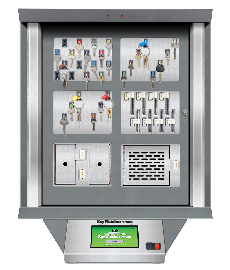
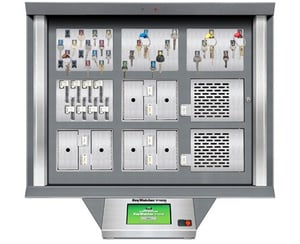
Key security for forklifts.

A forklift key left in the ignition or hanging on a pegboard makes it hard to know who is operating equipment and when. Electronic key control limits forklift access to certified operators and keeps a complete usage log, no sign-out sheet required.

keywatcher touch essen-1
Newcastle Systems
NB NU2-LFacing-Flat-Web@1x_1
  • Power and data where you need it

  • Ergonomic, flexible and built to more

  • Purpose-built for industrial environments

SupplyPoint
RotoFlex - Bright - LFacing
  • Real-time visibility and inventory control

  • Reduce waste, stockouts and costs
  • Tools and supplies always where your team needs them
www.morsewatchmans.comhubfsLogoMW_Green-and-black-Logo_RGB
KeyWatcher-Touch_gray-horizontal-with-9-mods_6-6-13-small-1
  • Control access to keys and assets

  • Full accountability and audit trails
  • Protect what matters most